The woodwind ensemble for this composition is divided into two groups: wind quintet (flute, oboe, clarinet, bassoon and horn) and flute trio. This instrumentation was chosen to literally reflect the Heart Chakra element of air. The suggested stage layout divides the ensemble into these two component groups, which, within the restrictions of the stage, allows the performers a certain amount of spatialisation. This corresponds to Anahata’s integral element of air through the avoidance of clutter that inhibits airflow. When performing, the audience should be in a circle around the ensemble, if practical.
Anahata is comprised of five sections (A-E). Sections A and E are performed by the flute trio and utilise non-traditional techniques (including pitch bends, key clicks, colour fingerings and edge tones) to produce a representation of the important aspect of air. This group also provides the continuous F drone throughout the piece that links the music to the Heart Chakra. The pitch C is used as the peak of the two principal phrases (illustrated in Examples IV-1 and IV-2 below); the range is contained between the associated pitches of F and C (with the exception of the lower Eb, which serves to decorate the lowest extent of the ambit: F).
The melodic materials employed by the wind quintet are deliberately lyrical, and are rhythmically conceived to allow a feeling of liberty and quasi-improvisational or ‘free’
sounding music. This is illustrated in Example IV-1 and Example IV-2:
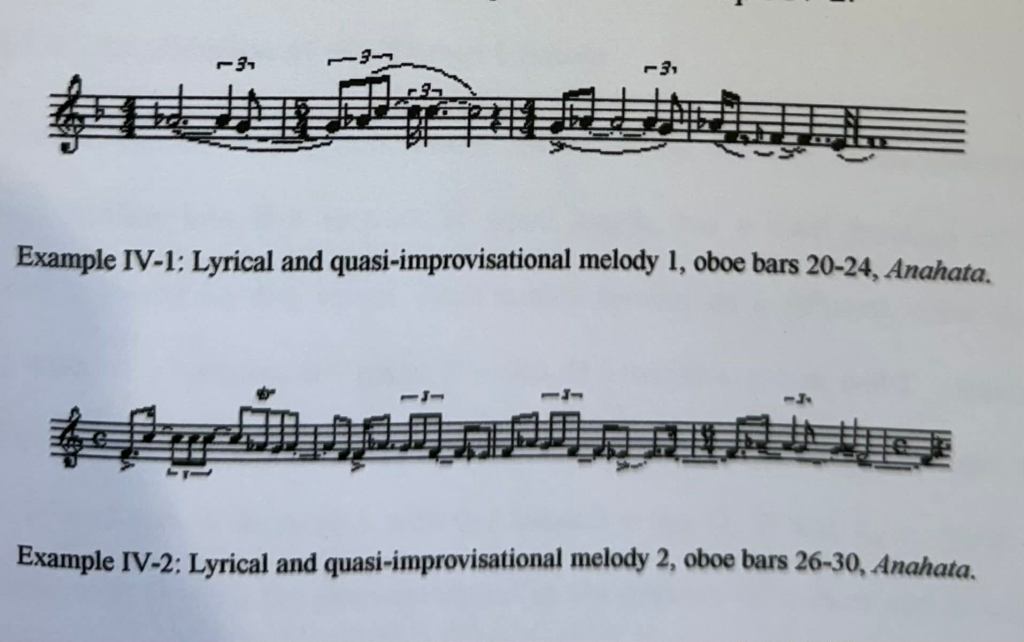
Sections B-D deal with the development of these two melodies. Variation is achieved primarily through the employment of counterpoint and fragmentation, combined with textural and timbral adaptations. The pitch content was created through the application of fragments (which are composed with the associated pitches of F and C in mind) rather than the conscious use of a particular overarching musical scale.
 Fiona Pennisi-Mitchell