Manipura, scored for piano duet (two pianos – four hands), is the development of two basic themes:
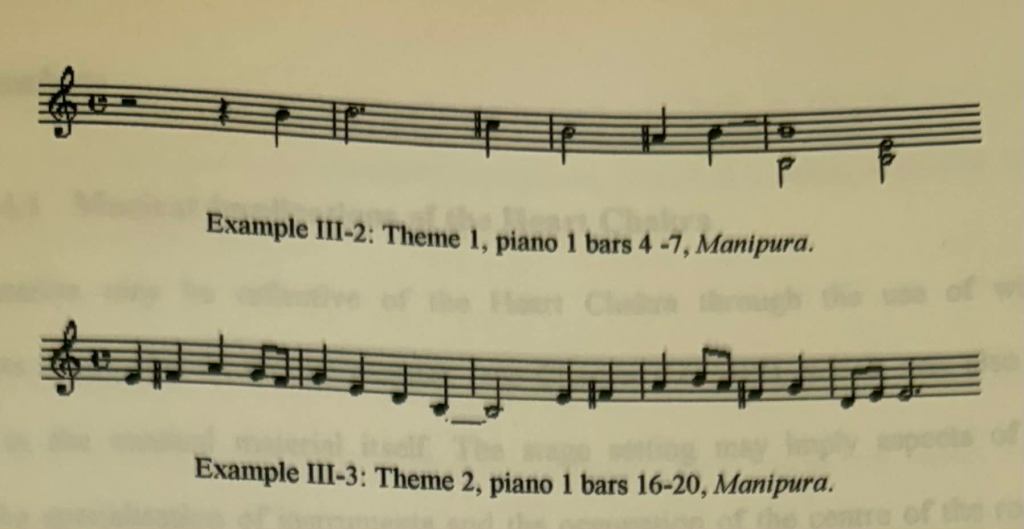
The pitches B and E are used as pedal points, whilst also being the tonal centres of theme 1 and theme 2 respectively. Being the third chakra and third movement in the work, the number three plays an important role in the foundation of Manipura: third intervals (of which tenth intervals [relative to lotus petals] are a type) are utilised throughout both themes and the piece is made up of three sections. After reviewing existent literature, it was decided that power (or control) was the key issue involved with the Abdominal Chakra, which also includes the opposite idea of freedom. Power is represented in these themes through the strong and steady nature of the melodies and the limited, or
“controlled’ range, articulation, harmony and rhythm.
The form of Manipura may be described as such:
| Section | Length | Description |
| A | 20 bars | Introduction of themes |
| B | 35 bars | Development of themes |
| C | 20 bars | Climactic restatement of developed themes |
Unlike the other movements in Wheels of Light, Manipura continues to climax until its end, closing with an extremely loud broad-ranged chord before abruptly fading into silence.
 Fiona Pennisi-Mitchell